
Substation SCMS
Substation Automation System Case Study: TAQA Transmission (TRANSCO) SCMS Upgrade Across Abu Dhabi Grid Stations
By Arch. Dany Dandachi, ALMAFOR, Abu Dhabi, United Arab Emirates
Published · updated
A substation does not usually announce that its control system is obsolete. It keeps switching, keeps feeding load, and keeps reporting to the control center, right up until a spare part cannot be found, a gateway drops its link to the dispatch center, or a defective controller forces operators back onto manual coordination. For a national transmission operator, that quiet obsolescence is a real risk. It is also exactly the problem a well-executed substation automation system upgrade is meant to remove.
This case study describes how ALMAFOR, working as main contractor, upgraded the Substation Control and Monitoring System (SCMS) across a group of Abu Dhabi grid stations for Abu Dhabi Transmission and Despatch Company (TAQA Transmission (TRANSCO)), and how the same engineering approach carried into related substation projects for Al Ain Distribution Company (TAQA Distribution (AADC)) and AD Ports Group. It is written for utilities, EPC contractors, and infrastructure owners who need to understand what a substation automation upgrade actually involves when the asset cannot be taken out of service for long.
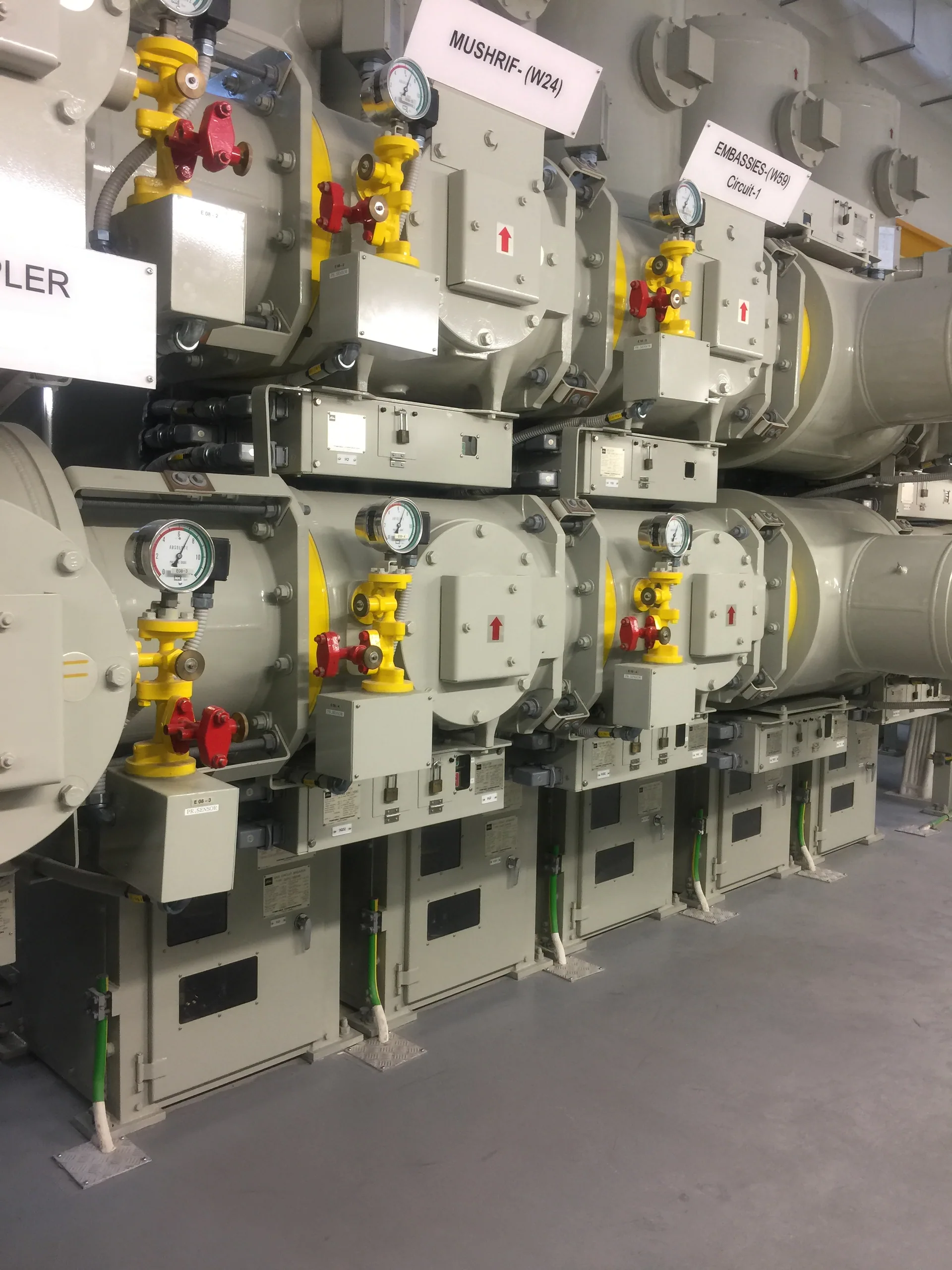 Gas-insulated switchgear at a TAQA Transmission (TRANSCO) grid station forming part of the SCMS/substation automation scope.
Project reference at a glance
| Project | N-15223 and N-15228, Upgrading, Modification and Replacement of Defective SCMS Equipment (Alstom/GE and Toshiba makes) |
| Client / End user | Abu Dhabi Transmission and Despatch Company (TAQA Transmission (TRANSCO)) |
| Stations | DHID 400/220 kV, MOSG 400/220/33/11 kV, KHZG 220/33 kV, PORT (E14) 132/11 kV, GLFA (W47) 132/11 kV, FLAH (E18/02) 132/11 kV |
| ALMAFOR role | Main Contractor |
| Core technology | Schneider Electric EcoFIT / EcoSUI based solution; C264 Bay Control Units; IEC 60870-5-101 gateways |
| Headline scope | 90 new BCUs (C264) installed and tested; redundant gateways for LDC/ECC and DMS; SCMS servers, HMI/EWS workstations, FO cabling, LAN switches, routers, GPS time sync, new UPS |
| Related substation projects | A-14239.1 SCMS with upper/lower ring upgrade at Al Khazna Grid (Client: TAQA Distribution (AADC)); 2101-320 New SCMS for 3 primary substations at Khalifa Port (Client: AD Ports Group) |
| Period | 2017-2025 |
| Location | Abu Dhabi and Al Ain, UAE |
What "substation automation system" actually means here
Before the engineering, a definition, because search engines and stakeholders both ask it. A substation automation system is the combined layer of intelligent electronic devices (IEDs), bay control units, protection relays, gateways, communication networks, and supervisory software that lets an operator monitor and control a substation remotely and safely. In transmission utilities it is often called an SCMS, a Substation Control and Monitoring System.
Sitting above it is SCADA. The SCADA full form is Supervisory Control and Data Acquisition, and in this context it is the dispatch-level system, at the Load Dispatch Center (LDC), the Energy Control Center (ECC), and the Distribution Management System (DMS), that receives data from each substation and issues remote commands. A substation automation upgrade succeeds only when the station-level SCMS and the utility-level SCADA agree on every point, every alarm priority, and every control path. If you want the deeper background, we cover it in what is SCADA in substations.
The starting point: defective controllers and end-of-life equipment
TAQA Transmission (TRANSCO) operates a fleet of grid stations built over many years, with SCMS equipment from multiple original vendors, Alstom/GE on one contract, Toshiba on another. Over time, controllers become defective, spare parts go end-of-life, and the communication architecture back to the control centers no longer matches current requirements. The stations still operate, but every fault becomes harder to diagnose and every modification carries more risk.
The challenge in this environment is never simply "install a new system." These are live 400 kV, 220 kV and 132 kV assets. The upgrade had to be executed station by station, bay by bay, with adaptation works inside existing local control panels (LCPs), without interrupting the transmission service the stations exist to provide. That constraint shapes every engineering decision that follows.
The substation automation system architecture
A recurring question from asset owners is what a modern substation automation system architecture should look like. Across the TAQA Transmission (TRANSCO) stations, the architecture followed the standard three layers, engineered for redundancy at each level.
At the bay level, ALMAFOR supplied and commissioned C264 Bay Control Units, 90 of them across the MOSG scope alone, together with AVRs, common alarm handling, and interfacing to existing protection relays, all wired back through the local control panels. The C264 is the workhorse of this design: it acquires status and measurements from the bay and executes control with the interlocking logic the utility requires.
At the station level, redundant SCMS station controllers, SCMS servers (CCA), HMI workstations, and engineering workstations (EWS) gave operators local supervisory control and a single, consistent view of the station.
At the communication and gateway level, redundant gateways were installed for the LDC/ECC (the 220 kV part) and separately for the DMS (the 33/11 kV part), using IEC 60870-5-101. This is where a substation automation project is won or lost, the new station link to the remote control centers, LDC (TAQA Transmission (TRANSCO)) and DMS (TAQA Distribution (ADDC)), had to be established and tested so that not a single point was lost or mislabeled in the transition. FO cables, LAN switches, routers, a GPS system with antenna for time synchronization, and new 5/6 kVA UPS units completed the backbone.
The whole solution was built on Schneider Electric's EcoFIT/EcoSUI platform. As an approved Schneider Electric system integrator, ALMAFOR could align the station engineering with the utility's chosen technology stack rather than forcing a translation layer between mismatched products.
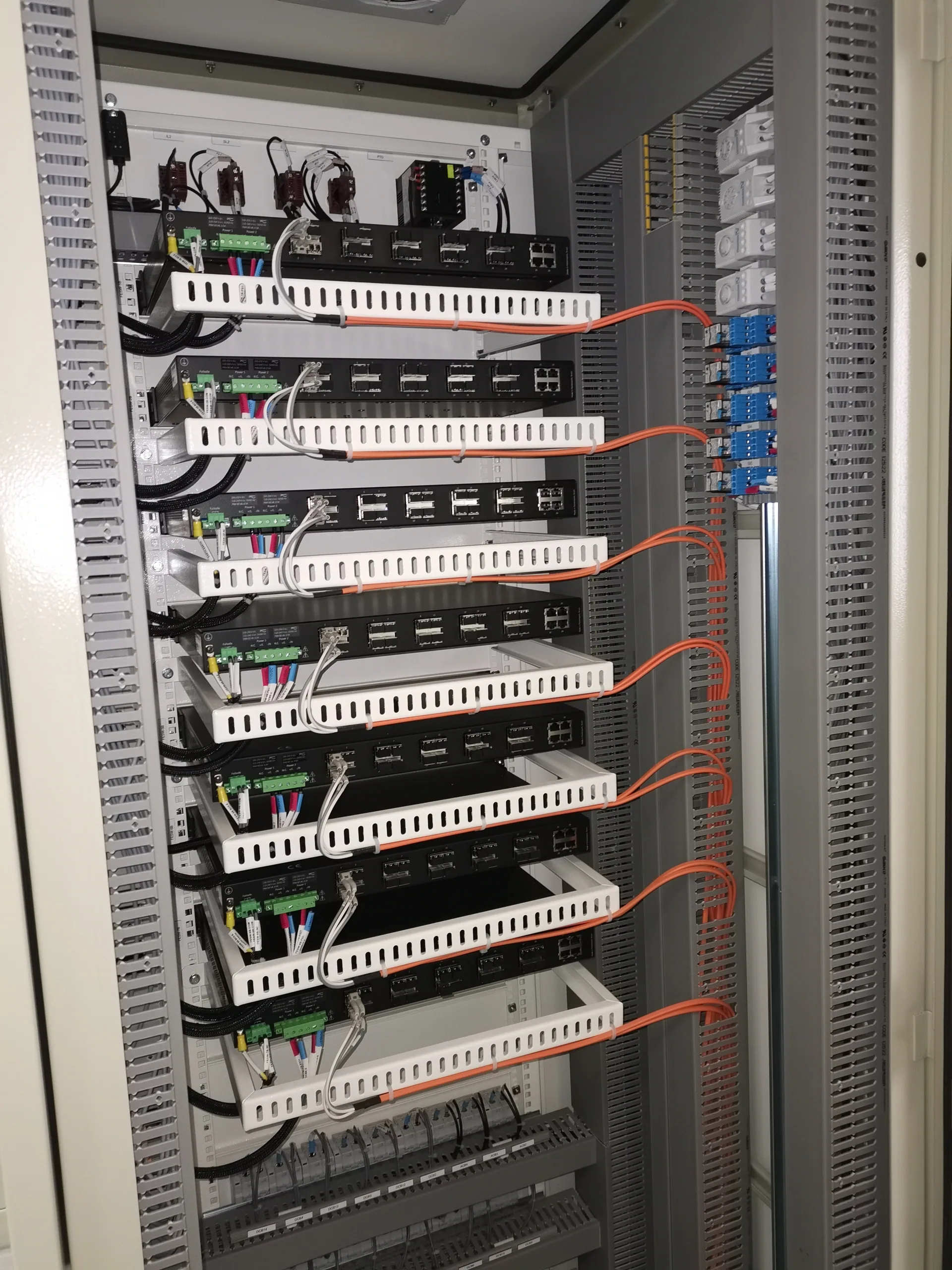 Managed switches and color-coded fiber patching in an SCMS communication cabinet, the network layer that carries every control and status point back to the dispatch center.
SCADA system integration: where the real work lives
The physical installation is visible. The SCADA system integration is not, and it is where most of the engineering effort actually went.
Every bay control unit publishes hundreds of points, breaker and isolator status, analog measurements, protection signals, alarms. Each of those points has to be mapped, named consistently, assigned the correct alarm priority, and verified end to end from the field device, through the station HMI, through the gateway, all the way to the LDC, ECC and DMS screens. On a brownfield transmission station, the existing drawings rarely reflect the field perfectly, so part of the scope was design engineering for the adaptation work inside the LCP panels, reconciling documentation with reality before a single point went live.
Hardwire interlocking, DMS integration, LDC integration, and, on the TAQA Distribution (AADC) Al Khazna contract, removal of the legacy ICCP link, are the kind of tasks that look small on a scope sheet and consume the commissioning schedule. Getting them right is the difference between a control room that trusts its screens and one that keeps a paper log "just in case."
The same discipline, three different clients
What makes this more than a single-project story is that the same substation automation approach transferred cleanly to adjacent projects:
-
A-14239.1, Al Khazna Grid (TAQA Distribution (AADC)). As main contractor, ALMAFOR supplied, installed, tested and commissioned BCU and SCMS panels and accessories at a 33/11 kV substation, including an inverter panel, hardwire interlocking, and DMS/LDC integration with legacy ICCP removal. Different distribution utility, same integration rigor.
-
2101-320, Khalifa Port (AD Ports Group). As main contractor, ALMAFOR designed, supplied, installed, tested and commissioned a new SCMS for three primary substations (KPZPRY-1, 2 & 3), replacing existing hardware and software. The scope deliberately extended beyond controls into site survey, detailed design, shop drawings, civil works, and IT/FO cable network connectivity, a genuinely turnkey substation automation delivery for a critical port asset.
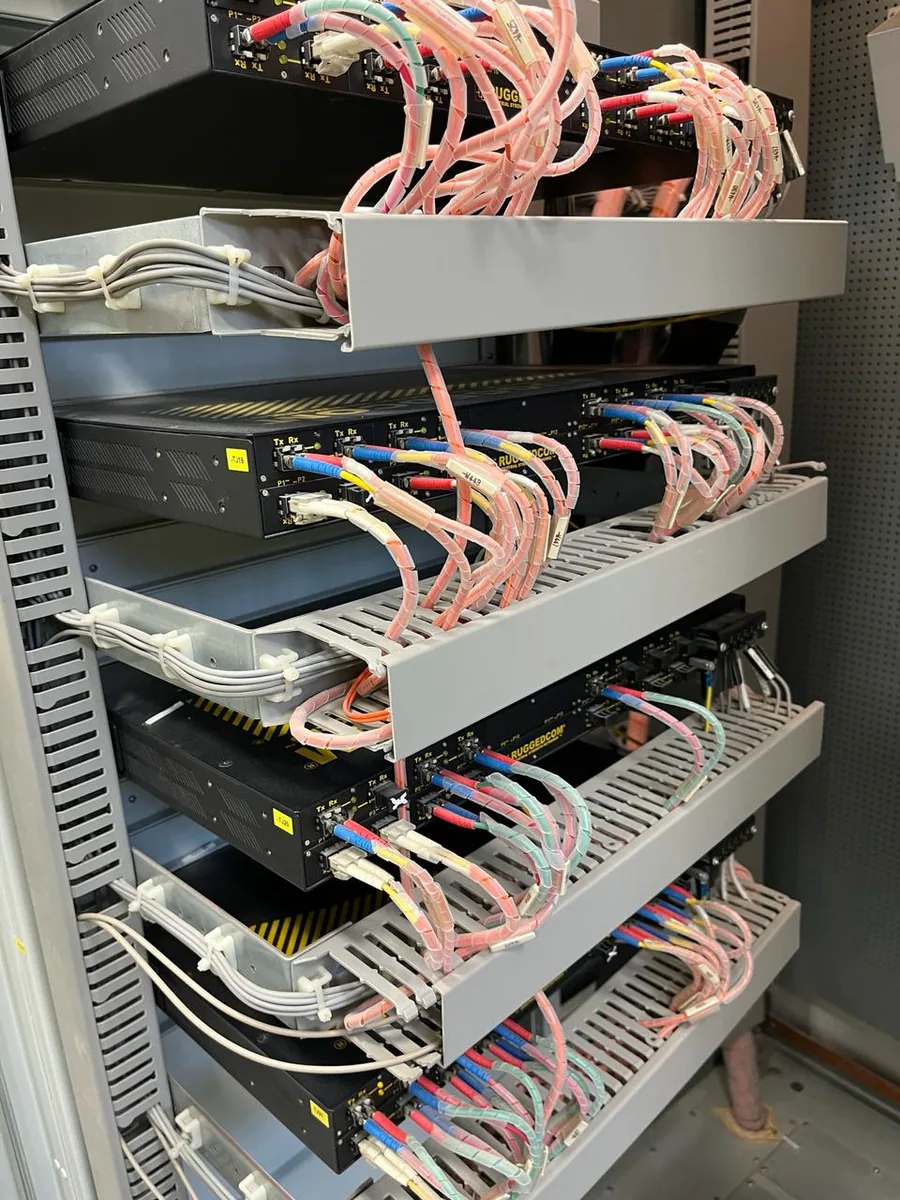 Industrial fiber switching for the new SCMS at Khalifa Port, part of the IT/FO network connectivity delivered as main contractor.
Why a turnkey substation automation contractor changes the outcome
On live transmission and distribution assets, fragmentation is the enemy. When one vendor supplies relays, another builds panels, another configures SCADA, and a fourth handles civil and cabling, the interfaces between them become the failure points, and during commissioning, nobody owns the system behavior end to end.
ALMAFOR delivered these projects as a single accountable contractor covering design, panel adaptation, installation, SCADA integration, FO and network works, testing, and commissioning. On a station that cannot be switched off, that single line of accountability is not a convenience, it is what allows phased cutovers, quick resolution when field conditions differ from drawings, and clean integration back to the control centers.
For infrastructure owners evaluating industrial automation companies in Abu Dhabi for this kind of work, the practical test is not the length of a product brochure. It is whether the contractor can carry a live substation from defective legacy controllers to a fully integrated, dispatch-connected automation system without losing service, and prove every point in the transition.
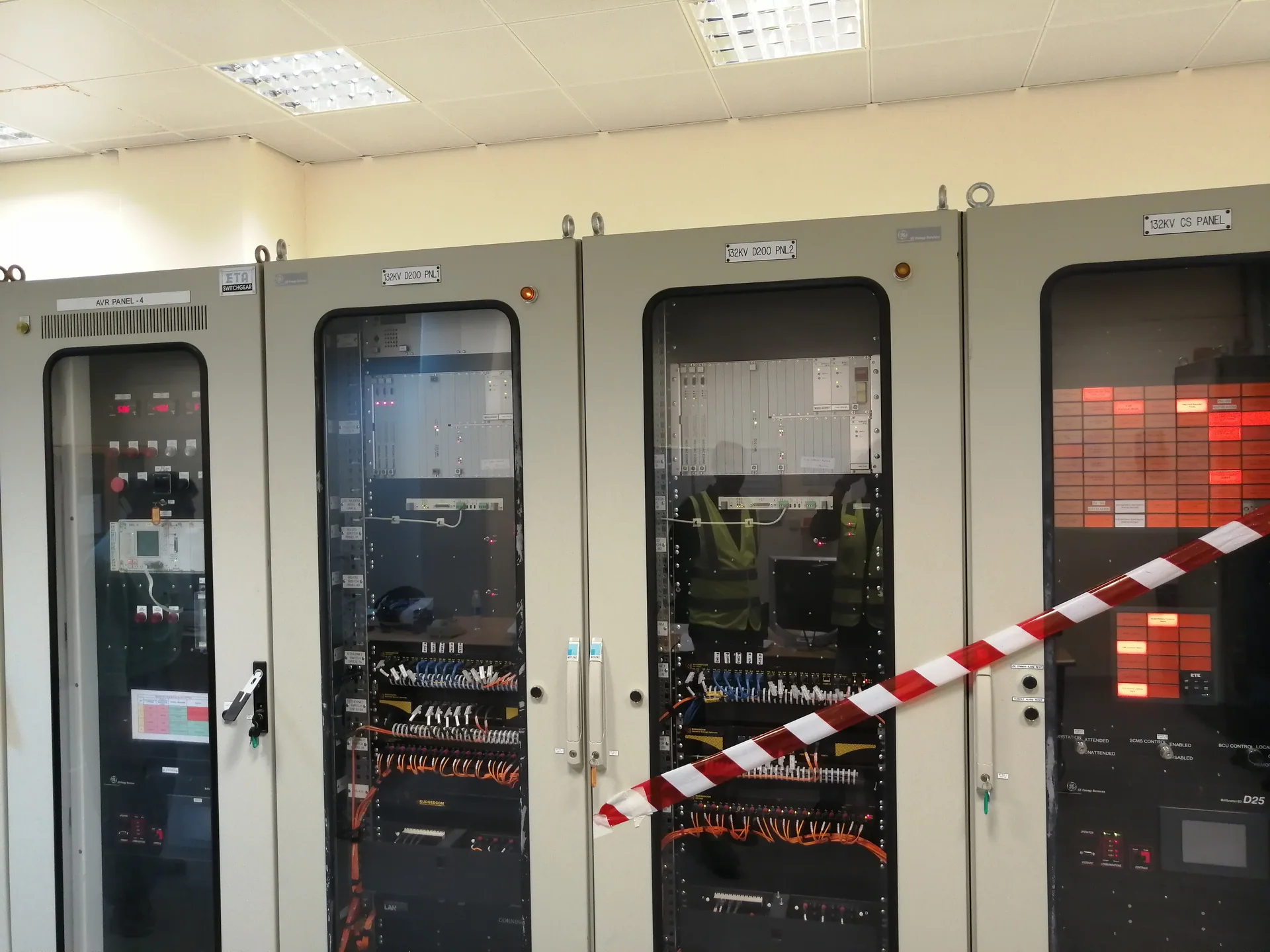 A TAQA Transmission (TRANSCO) substation control room with protection and control panels integrated into the upgraded SCMS.
Trade-offs owners should weigh
Not every substation needs the deepest automation. A remote 11 kV distribution point may need dependable telemetry and alarm handling; a 400 kV grid station justifies full redundancy at bay, station, and gateway levels. The right depth is set by asset criticality, spare-parts risk on the existing equipment, and how much outage window the operator can tolerate.
There is also the standardization question. A common architecture and naming convention across a station fleet makes every future upgrade cheaper and every operator transfer easier, but it must still leave room for the genuine differences between a 400/220 kV transmission node and a 132/11 kV substation. And because these systems are increasingly connected to central control, network segmentation, access control, and a clear recovery strategy belong in the design from day one, not after commissioning. For greenfield stations, the same principles map onto an IEC 61850 architecture.
What this substation automation system case study proves
The measure of success on these projects was not a screen, it was continuity. Six TAQA Transmission (TRANSCO) grid stations across three voltage tiers, a distribution grid at Al Khazna, and three primary substations at a working port were carried from ageing or defective control equipment to modern, redundant, dispatch-integrated substation automation systems, station by station, without sacrificing the service they exist to deliver.
That is the standard ALMAFOR brings to substation automation and SCADA system integration across Abu Dhabi and the wider UAE: full-system engineering, executed on live assets, owned end to end. When a control system upgrade is judged years later, during a switching event, at 2 a.m., under load, that discipline is what keeps the operator confident in what the screen is telling them.
ALMAFOR is an ISO 9001:2015 and ISO 45001:2018 certified electrical, automation and control-systems contractor based in Abu Dhabi, UAE, and an approved Schneider Electric system integrator registered with TAQA Distribution (ADDC), TAQA Distribution (AADC), Etihad Water & Energy and ADSSC. Author: Arch. Dany Dandachi, ALMAFOR engineering and project delivery team.
Related case studies: Irrigation & Pump Station SCADA in Abu Dhabi · Energy Management & Building Automation, Al Bahr Towers
The wider discipline behind this project is described on our SCADA integration service page.
We want to hear from you
Tell us about the system you need built, upgraded or kept running.