
Project
Pump control panels with RTU and SCADA integration, 12 irrigation pump sets
Twelve duty and standby irrigation pump sets at Al Falah, Mohammed Bin Zayed City, Al Fou'ah and Rabadan parks, each brought onto the municipal SCADA over DNP3
About this project
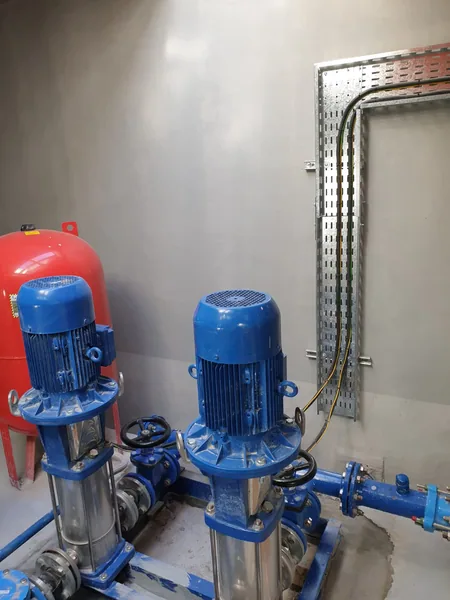
Four park developments needed their irrigation pumping automated to the same municipal standard at the same time. Al Falah Park took one pump set, Mohammed Bin Zayed City parks took five, Al Fou'ah parks in Al Ain took three and Rabadan parks took three. Twelve sets in total, every one of them a duty and standby pair, running either a 5.5 kW three phase vertical pump or a 2.5 kW single phase pump.
Work started in August 2024 and the first stations were handed over in January 2025.
The interesting constraint on a job like this is not any single station. It is that twelve of them have to behave identically. Each site gets an MCC with variable frequency drives for the pumps, a PLC and HMI for local control, and a separate RTU that reports to the Department of Municipalities and Transport irrigation SCADA over DNP3. If the tag names, alarm priorities and duty changeover logic differ from one park to the next, the operations team inherits twelve small dialects instead of one system.
So the engineering effort concentrates on the template rather than the individual panel. Get the I/O list, the DNP3 point map, the control philosophy and the panel layout right once, then repeat them with only the pump ratings and site specifics changing. That also makes the site work faster, because an electrician terminating the ninth panel is terminating a layout they already know.
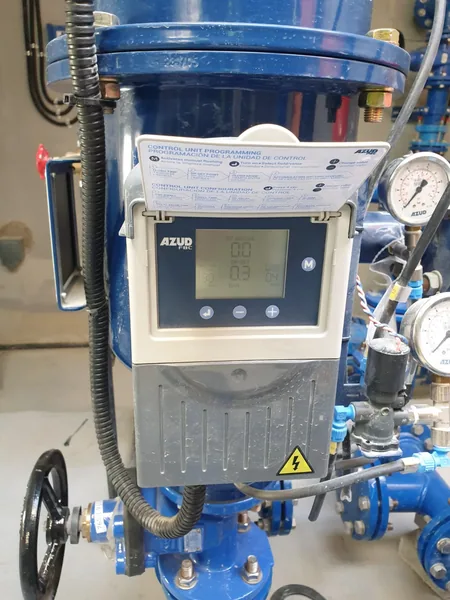
Field instrumentation followed the same discipline. Level and pressure transmitters carry local indication as well as feeding the controllers, so a technician standing at the station can read the process without a laptop and without calling the control room. Float switches and conductivity level switches sit behind the analogue measurement as an independent backup, which is what the municipal specification asks for and what keeps a station running when a transmitter drifts.
Battery and charger sets back the PLC and RTU at every station, so a station that loses mains still reports that it has lost mains. A remote station that simply goes quiet tells the control room nothing about whether the problem is power, communications or the pump itself.
Scope of work
- Supply, installation, programming, testing and commissioning of the RTU at each station, integrated with the municipal irrigation SCADA over DNP3
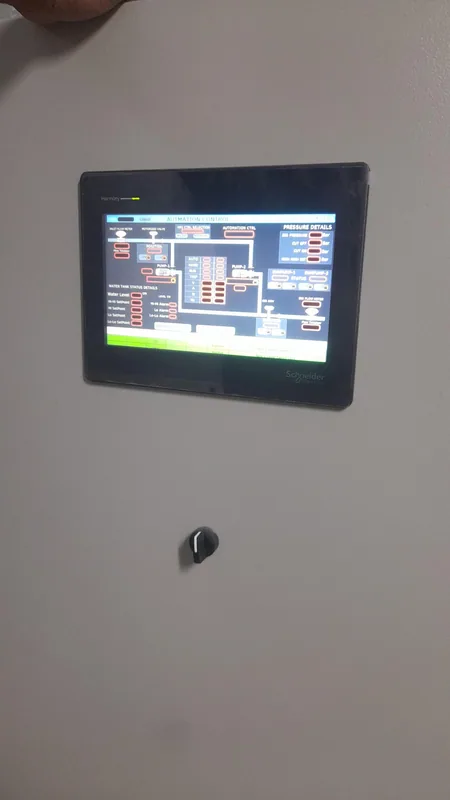
- MCC control panel with PLC, HMI and 5.5 kW variable frequency drives for pump speed control
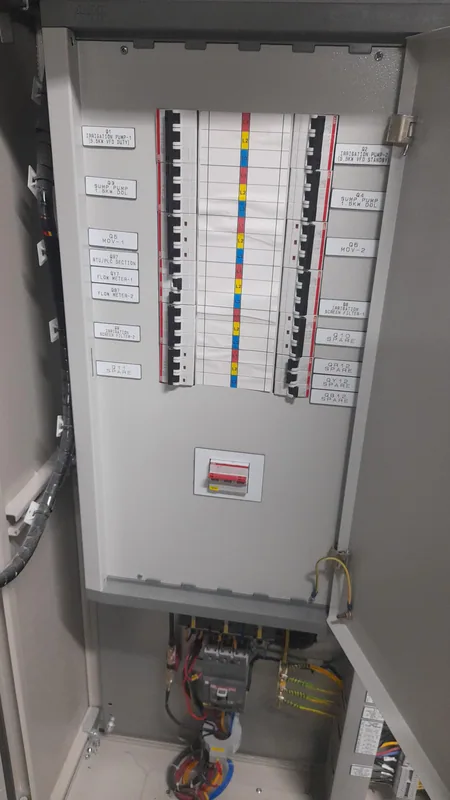
- Incoming MCCB distribution with earth leakage protection, metering, power monitoring and signal segregation
- Outgoing supplies for irrigation pumps, sump pumps and motorised valves, with auto, off and hand selection and run and trip indication
- Level and pressure transmitters with local indication, wired back to both the RTU and the PLC panel
- Pressure gauges, pressure switches, float switches, conductivity level switches and proximity switches
- Battery and battery charger backing the PLC and RTU, to the municipal standard
- Instrument cabling, containment and termination between the MCC and the field devices
Equipment installed
- PLC and HMI in the control panel, with an independent RTU for the SCADA link
- 5.5 kW variable frequency drives on the three phase pump sets
- Main incomer MCCB distribution with earth leakage protection, metering and a power monitoring unit
- Level transmitters and pressure transmitters with local indication
- Pressure gauges, pressure switches, float switches, sump conductivity level switches and proximity switches
- Battery and battery charger backing the PLC and RTU
- DNP3 link from each station RTU to the municipal irrigation SCADA
Planning similar work?
Talk to the engineers who delivered this project.
Trusted By