
Substation SCMS
Port Substation Automation Case Study: New SCMS for Three Primary Substations at Khalifa Port
By Arch. Dany Dandachi, ALMAFOR, Abu Dhabi, United Arab Emirates
Published · updated
A working port does not stop so you can rebuild the brains of its substations. Cargo keeps moving, cranes keep drawing power, and the network behind them has to stay visible and controllable every hour of the changeover. So when Abu Dhabi Ports set out to replace the supervisory control and monitoring systems across three primary substations at Khalifa Port, hardware and software both, all end-of-life, the brief came with a hard edge: modernise the control layer of a live, revenue-critical port, and do it inside a single contract year. This is the case study of how Almafor delivered that scope as main contractor: a full substation automation system replacement on a Hitachi Energy platform, the fibre-optic connectivity that ties it into the port’s IT network, and the civil works that carry it, across KPZPRY-1, KPZPRY-2 and KPZPRY-3, without any of the three stations losing sight of its power. It is a useful reference for infrastructure owners, ports and utilities weighing how to retrofit control systems on assets that cannot be switched off.
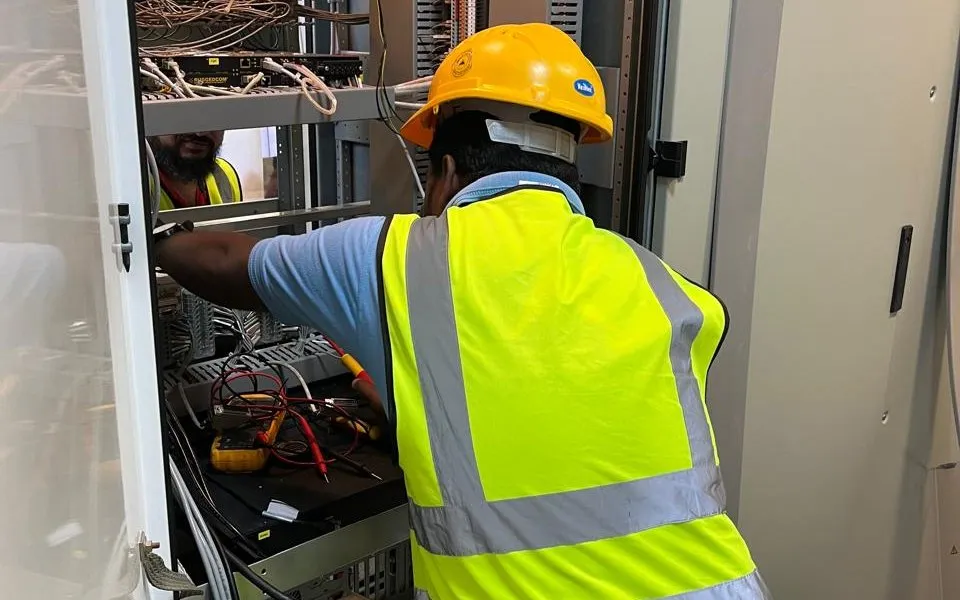
Project reference at a glance
| Client | Abu Dhabi Ports (AD Ports Group) |
|---|---|
| Project | New SCMS for three primary substations at Khalifa Port (Contract 2101-320) |
| Stations | KPZPRY-1, KPZPRY-2, KPZPRY-3 |
| Almafor role | Main contractor, turnkey (design, supply, install, test & commission) |
| SCMS OEM / platform | Hitachi Energy |
| Scope | Full SCMS hardware and software replacement, protection-relay (IED) re-integration, ~1 km fibre-optic connectivity, manhole and duct civil works, FAT, SAT, training and handover |
| Standards | ADDC SCMS specifications; site acceptance to ADDC guidelines |
| Timeline | February 2024 to February 2025, delivered within the twelve-month contract |
| Location | Khalifa Port, Al Ma’Mourah, Abu Dhabi, UAE |
What "SCMS replacement" actually means on a live port
A Substation Control and Monitoring System (SCMS) is the automation layer of a substation. It reads the live state of every bay: breaker and isolator positions, currents, voltages, transformer status, protection and alarm signals, through the intelligent electronic devices (IEDs) sitting on the primary plant. It presents that picture to operators through servers and workstations, and it carries operator commands back to the switchgear safely. If the SCMS fails, the copper and steel stay energised, but the people responsible for the port’s power can no longer see or operate the station from where the decisions are made.
Replacing an SCMS is therefore not a like-for-like box swap. The new servers, switches and workstations have to re-establish a conversation with every existing protection relay and alarm unit already wired into the substation, reproduce the station’s control and monitoring behaviour exactly, and do all of it without disturbing the switchgear, transformers, cooling or fire systems that keep the port fed. That is the work this project turned on.
The starting point: end-of-life control, partly blind
The three Khalifa Port substations were running a first-generation SCMS that had reached the end of its serviceable life. The condition across the three stations was uneven and, in places, precarious: one station still had a working server, while the others had lost theirs, leaving the control layer down to a single point of failure or effectively blind. Ageing network switches were a further risk: some were still passing traffic, others were no longer even reachable for configuration.
For a port whose substations feed continuous operations, that is not a state you leave in place and it is not a state you can fix with a weekend outage. The only acceptable path was a full replacement: new servers, workstations, switches, firewalls and SCMS software across all three stations, executed while each substation stayed in service and under supervision throughout.
The substation automation architecture we deployed
As main contractor, Almafor took the whole chain, from survey to handover. The delivered architecture at each of the three stations comprised:
- New SCMS servers and operator workstations, with KVM, replacing the failed and end-of-life units, a current, supportable platform in place of an unsupportable one.
- New managed network switches in place of the ageing units, rebuilding a reliable station communication network.
- New firewalls at each substation, giving the control network a defensible boundary rather than the flat, exposed posture of the legacy installation.
- The Hitachi Energy SCMS platform, configured to reproduce each station’s control and monitoring behaviour and licensed in Abu Dhabi Ports’ own name.
- Re-established communications to every existing IED, the protection relays, AVRs and alarm units already installed on the primary plant, so the new SCMS saw the whole station from day one of cutover.
Before any of that was procured, the work began with a comprehensive site survey of the existing communication, common-alarm, gateway, front-end and inverter panels at each station, followed by detailed design and shop drawings coordinated with Abu Dhabi Ports and its stakeholders. The new hardware was then built and Factory Acceptance Tested before it ever reached the port.
Integration: talking to the protection and to the port network
The engineering that decides whether an SCMS retrofit succeeds lives in two integrations. The first is southbound, to the primary plant: the new SCMS had to re-establish communication with each existing protection relay and alarm unit, and where the legacy IEDs required it, Almafor coordinated with the equipment’s original OEM to close out the interfacing. The station had to look the same to operators after the swap as it did before, only supportable.
The second integration is northbound, to the port itself. Each substation’s new SCMS was connected back to the nearest Abu Dhabi Ports building so the systems sit on the port’s IT intranet: the KPZPRY-1 and KPZPRY-2 systems were linked to one AD Ports building, and KPZPRY-3 to another. That connectivity was carried on new fibre-optic cable, terminated and tested to ADDC standards, the physical link that lets the port’s IT environment reach the substation control systems as intended.
The fibre and the civil works that carry it
Connectivity is only as good as the route it runs on, and a port yard is not a place you can simply pull a cable across. This scope therefore included roughly a kilometre of fibre-optic cable between the substations and the AD Ports buildings, professionally terminated and tested to ADDC standards so the optical link met specification before it carried a single packet.
Carrying that fibre meant civil works, and this is where a single-contractor scope earns its keep. Rather than hand the trenching and ducting to a separate party and manage the seam, Almafor delivered the civil scope directly: new manholes, extensions to the cable-duct network with fresh duct sleeves, and the excavation and reinstatement around them. Because the same team owned both the SCMS installation and the route it ran on, the connectivity was ready when the systems were, instead of becoming the bottleneck that so often strands an automation project at the final hurdle.
How three substations were replaced inside a year
Replacing the control systems of three substations on a live port inside twelve months is a sequencing achievement, not a shortcut. Four decisions made the programme land:
- Factory-test before site. Each station’s SCMS was built and Factory Acceptance Tested before delivery, so on-site installation windows were short, predictable and low-risk rather than open-ended debugging sessions.
- Work the three stations in parallel. KPZPRY-1, KPZPRY-2 and KPZPRY-3 were surveyed, installed and commissioned concurrently, rather than finishing one station before starting the next, the single biggest lever on the overall schedule.
- Stage each changeover on the live asset. At each station the primary plant kept running while its control layer was swapped, with each new system proven on ADDC-standard site acceptance tests before handover.
- Run the civil and fibre scope alongside the SCMS. Trenching, manholes, ducting and fibre progressed in step with the control-system work, so IT connectivity was never the item everyone waited on at the end.
The outcome: all three substations replaced, tested, commissioned and handed over, with provisional acceptance signed across the full scope inside the contract year.
Why a responsive OEM changed the outcome
A live, three-station changeover on a one-year clock only works if the platform vendor moves at the pace of the site team. On this project that partner was Hitachi Energy, and the responsiveness mattered. Fast turnaround on configuration, test support and the inevitable field questions kept the sequence from Factory Acceptance Test to Site Acceptance Test to commissioning tight, with no station stalled waiting on the platform side. It is the kind of OEM relationship that never appears in a specification but quietly decides whether a programme finishes on time, and here it did.
What this case study proves
Three end-of-life, partly-blind control systems became three current, supportable Hitachi Energy SCMS installations, fully integrated with the existing protection, tied into the port’s IT network over new fibre, and carried on civil works built to last, all delivered on a live port, inside a twelve-month contract. The combination that made it possible is worth naming for any owner planning similar work: a decisive client in Abu Dhabi Ports, a responsive OEM in Hitachi Energy, and a single accountable contractor holding design approvals, testing, commissioning, fibre and civil works in one hand so nothing critical fell between trades and the schedule held.
For infrastructure owners, ports and utilities evaluating substation automation companies in Abu Dhabi, that single-accountability model is the point: the control philosophy, the network, the fibre and the ground it runs through, delivered and answered for by one team.
About the team that delivered this
Almafor (legal name Almatin Forinter) is a substation automation and SCADA integrator based in Abu Dhabi, delivering SCMS retrofits, SCADA, panel building, irrigation automation, BMS and MEP electrical installation for AD Ports Group, TRANSCO, ADDC, TAQA Transmission, TAQA Distribution and the Department of Municipalities and Transport. The company has operated in the UAE since 2008, with delivery experience up to 400 kV. The Khalifa Port SCMS project is one of a portfolio of substation automation works executed across the Abu Dhabi network. See also our TAQA Transmission (TRANSCO) SCMS upgrade and irrigation and pump-station SCADA case studies.
Related case studies
We want to hear from you
Tell us about the system you need built, upgraded or kept running.