
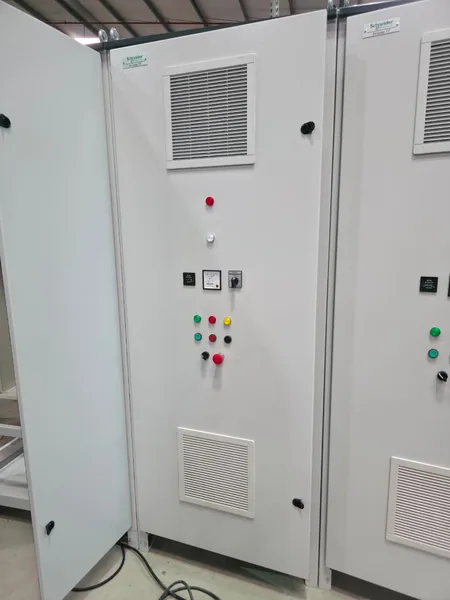
Stormwater lifting station control panel, Al Hamra Zone 2
Al Hamra Zone 2 development, to Etihad Water and Electricity specifications
Date2026-01-27
CategoryAutomation, Panel Building
Guide
A VFD control panel is not a drive in a box. The drive is a catalogue item. The panel is the engineering around it, and that is where the job succeeds or fails.
The short answer
A VFD control panel houses one or more variable frequency drives together with everything the drives need to run a real load: the incoming supply and its protection, the control logic that decides when and how fast the motors run, the operator interface, and the terminals where the site cables land. In pumping work, which is most of what we build them for, the panel usually carries a duty and standby pair of drives, the changeover logic between them, and the instrumentation inputs the speed control runs on.
The drive itself is the smallest decision. What separates a panel that runs quietly for years from one that becomes a maintenance item is the thermal design for a UAE ambient, the enclosure choice for where the panel actually stands, the segregation between power and control, and whether the whole assembly was function tested before it left the workshop.
Almafor designs and builds VFD control panels in its own workshop in Mussafah Industrial Area, Abu Dhabi, then installs, terminates and commissions them. The recent examples on this page range from 5.5 kW irrigation pump sets to a 2x90 kW stormwater lifting station.
Inside the panel
The variable frequency drives themselves, sized to the motor and the duty. On duty and standby pumping the pair alternates; on duty and assist the second drive joins the first when demand rises. Those are different designs, not settings.
The incoming breaker, earth leakage protection, metering and power monitoring, and where the network demands it, power factor correction. On one recent reservoir pumping station the capacitor bank was built and factory tested alongside the MCC.
A PLC or RTU running the sequence, level and pressure inputs, and the link outwards: DNP3 to a municipal SCADA, GSM telemetry on remote sites, or interfacing to the pump maker's own motor protection modules.
HMI, selector switches, run and trip indication, and an enclosure chosen for the location: sheet steel indoors, GRP outdoors, with form separation to the specification, Form 2B and Form 4 both in current use.
Before you order
Track record
Every panel below was built in our Mussafah workshop, factory tested, then installed and commissioned by the same team.
Al Hamra Zone 2 development, to Etihad Water and Electricity specifications
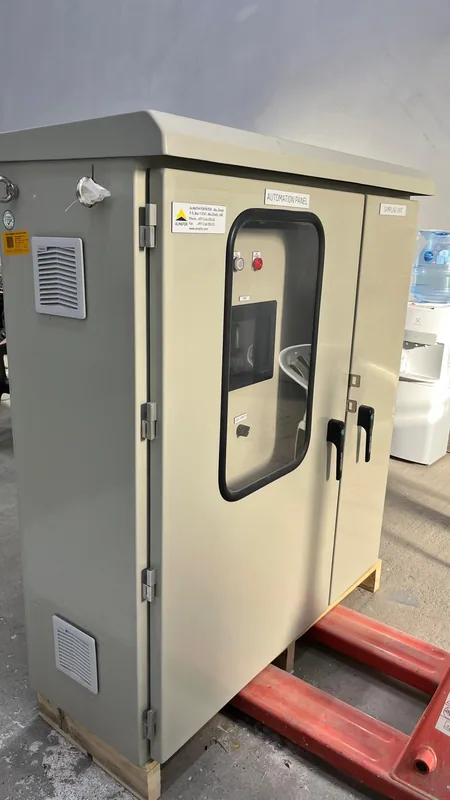
Bawabat Al Sharq Development
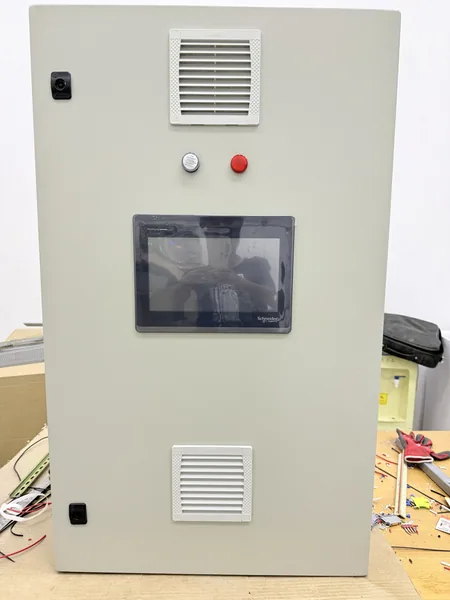
Department of Municipalities and Transport, Abu Dhabi (DMT)
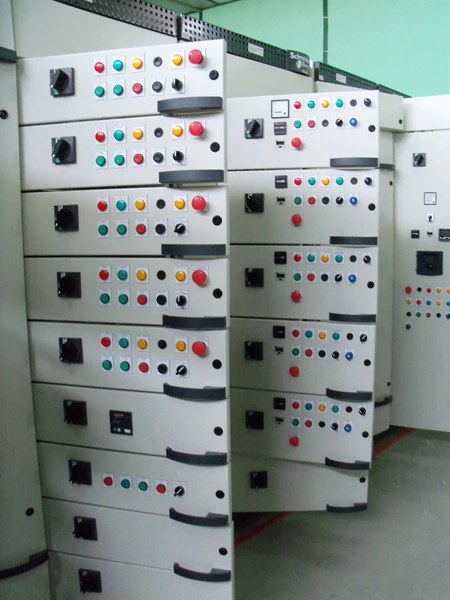
Abu Dhabi Municipality
Components
Component selection follows the client specification and the asset owner's approved vendor list. Most of our recent VFD panels are built on Schneider Electric drives, Altivar among them.
Build process
Single line diagram, schematics, general arrangement and bill of materials, issued for client and consultant approval. Where the consultant instructs that the issued SLD is followed without modification, compliance is proved line by line.
Enclosure preparation, busbar, drive mounting with its cooling clearances, and wiring to the approved schematics with power and control segregated.
Drives parameterised, controller loaded, and the panel powered in the workshop. A fault found here costs an afternoon.
Function tested against the approved schedule with the client and consultant present. On the Bawabat Al Sharq station the MCC, the capacitor bank and the PLC each had their own witnessed FAT.
Delivery, termination, loop checks, and testing and commissioning on site by the team that built the panel, through to the signed report.
Common questions
A panel that houses one or more variable frequency drives with their supply protection, control logic, operator interface and field terminals, so a motor can run at controlled, variable speed rather than being switched hard on and off. In pumping applications the panel usually carries two drives on duty and standby with automatic changeover.
A starter panel switches the motor across the line at full speed. A VFD panel controls the motor's speed continuously, which for pumps means the flow follows demand, starting currents are low, and pressure surges are avoided. The price is more heat to manage in the panel and more engineering in the design, which is why enclosure and thermal choices matter more on VFD work.
Recent panels run from 5.5 kW duty and standby irrigation pump sets, through 7.5 kW park pump stations, to a stormwater lifting station running two 90 kW pumps on duty and assist. On drive replacement work we have delivered a 315/250 kW low harmonic variable speed drive into an existing TRANSCO pump station.
Decided by where the panel stands, not by price. Outdoors in the UAE we build GRP, because a steel enclosure in full sun becomes a corrosion and heat problem. Indoors, sheet steel. On one Al Ain parks programme that split ran to six sheet steel panels and three GRP.
They can, and on larger drives the network operator may require mitigation or a low harmonic unit. The 315/250 kW drive we installed at a TRANSCO pump station was specified low harmonic for exactly that reason. On small pump sets it is rarely the governing issue, but it should be asked about, not assumed.
Yes, and most of ours do. Municipal irrigation and stormwater panels we build carry an RTU reporting over DNP3 to the operator's SCADA; remote sites use GSM telemetry; and where the pump manufacturer provides motor protection modules, we interface them so the station reports why it stopped, not just that it stopped.
Every panel is function tested in our Mussafah workshop before it ships, and clients are welcome to witness the factory acceptance test. Finding a wiring error on the shop floor costs an afternoon; finding it on an energised site costs a return visit and someone else's programme.
It depends on the drive rating, the duty, the enclosure, the instrumentation and the approvals required, which is why we quote against a single line diagram rather than publish a price list. Our guide to automation project costs explains the drivers honestly.
Related
Tell us about the system you need built, upgraded or kept running.