
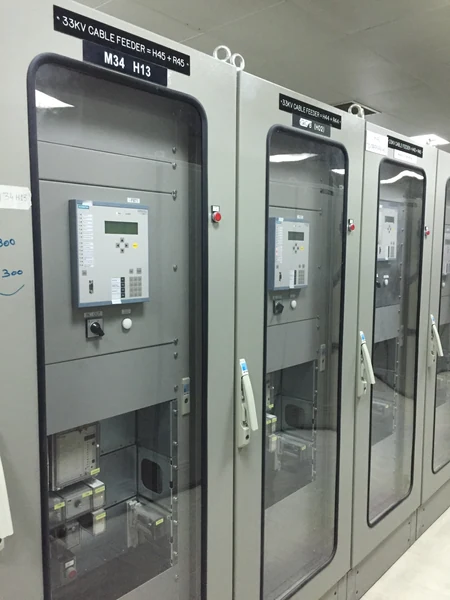
TAQA TRANSMISSION- Mussafah Substation
TAQA Transmission
Date2023-02-10
CategoryAutomation, Panel Building
Guide
On a substation control system the equipment list is the easy half. The outage sequence is what decides whether the job finishes.
What sets it apart
A factory can usually be stopped. A transmission substation feeding a city cannot, and that single constraint reshapes everything: how the design is staged, how the panels are built, when cables can be pulled, and how a new system is proved before the old one is decommissioned.
It also narrows the field of contractors sharply. Plenty of firms can configure a SCADA package. Far fewer have stood in an energised 220kV station with a bay out on a permit, a limited window, and a client operator watching a busbar that must not be disturbed.
Almafor has done substation control and monitoring work for TAQA Transmission and TAQA Distribution, and a new SCMS across three primary substations at Khalifa Port on Hitachi Energy hardware. This page is about how to tell whether a bidder has genuinely done that.
Anatomy
Understanding the layers helps because bidders often quote strongly on one and thinly on the others.
Bay control units and protection relays, one set per bay, doing the interlocking and local control. Volume matters here: one station on the TAQA Transmission network required ninety C264 bay control units, each configured, wired and proved individually.
Station controllers, HMI and engineering workstations, the station bus, time synchronisation and the historian. This is where the operator actually works, and where a poor design is felt every shift.
Redundant gateways out to the load despatch centre and to the distribution management system, on IEC 60870 or IEC 61850. On the Mussafah substation this meant separate redundant gateway pairs for the 220kV and the 33/11kV parts.
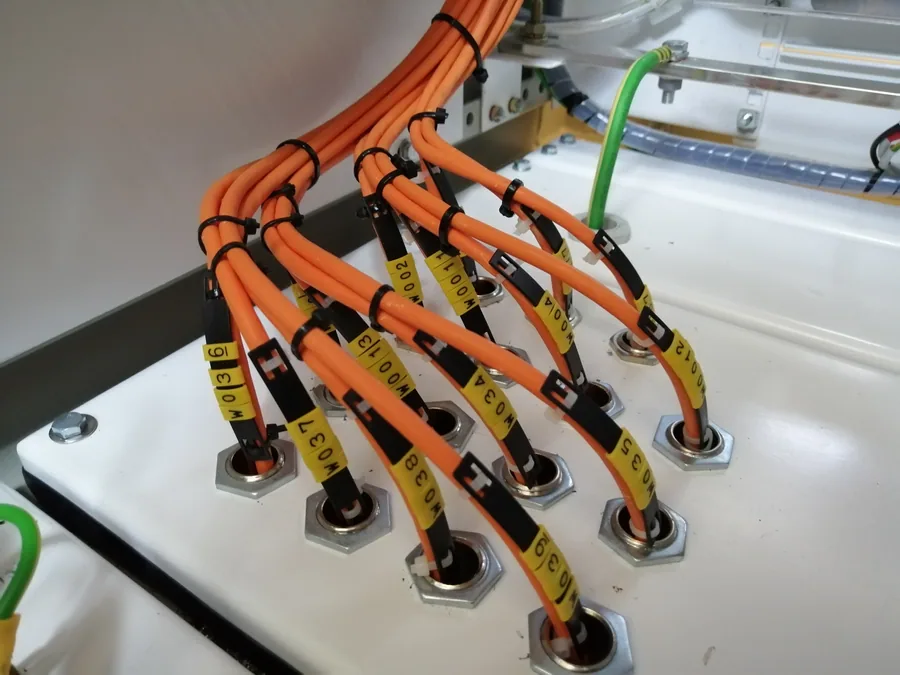
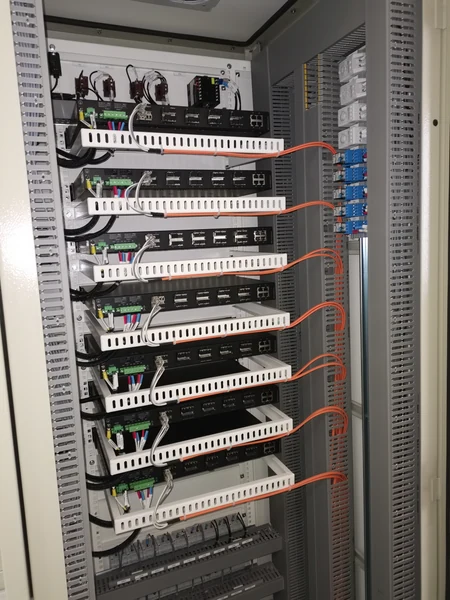
Fibre optic cabling, LAN switches, routers, UPS and inverter panels. Unglamorous, routinely underpriced, and the usual cause of intermittent faults that take weeks to find.
Assessment
Track record
Transmission and distribution, new build and replacement, all on stations that stayed energised.
TAQA Transmission
TAQA - Transmission
TAQA Distribution
Platforms
Sequence
Record what is installed rather than what the drawings say. On stations commissioned in the 1990s and 2000s the two differ often enough that we treat this as the first deliverable.
Which bays come out, in what order, for how long, and what the fallback is if a window overruns. The design then follows the sequence rather than the other way round.
Configured, powered and function tested in the Mussafah workshop with the client present. A panel that arrives untested consumes an outage window that cannot be bought back.
The existing system stays available until the new one is proved on that bay. Nothing is decommissioned on the strength of a drawing.
Interlocking and permissives tested with the client's engineers watching, bay by bay. This is the test that protects people, so it is not compressed when the programme slips.
Telecontrol proved to the control centre, site acceptance completed, as built documentation and operator training delivered.
Common questions
A substation control and monitoring system: the bay control units, station controllers, HMI, gateways and communications that let a substation be operated and monitored locally and from a control centre. It sits alongside the protection system rather than replacing it, and the boundary between the two should be explicit in any specification.
Not with zero outage, but without taking the station out of service. It is done bay by bay inside windows agreed with the operator, running the old and new systems in parallel until each bay is proved. The Khalifa Port contract covered three primary substations on that basis.
It is the direction of travel and it is specified on most new UAE transmission work, but a lot of installed plant still runs IEC 60870 or hardwired interfaces. A realistic scheme often has to speak both, and a contractor who has only ever worked on greenfield 61850 stations may struggle on a retrofit.
Design approval with the asset owner and the availability of outage windows set the programme, not the engineering. A contractor already registered with your asset owner clears the first faster, which is why approval status is worth confirming before award.
Yes. The Mussafah substation contract for TAQA Transmission covered redundant gateways for the 220kV part to the load despatch and emergency control centres, and for the 33/11kV part to the distribution management system, plus station controllers, fibre, switches and workstations.
Related
Tell us about the system you need built, upgraded or kept running.